



Dear Friend,
I’ve got vertigo.
Somehow I’ve developed a full-on, Alfred Hitchcock, world-spinning kind of vertigo. I swear it wasn’t there two weeks ago. But ever since my business partners and I went to the Apple Store to demo the Apple Vision Pro goggles (tough day at work), the room has been doing many a pirouette.
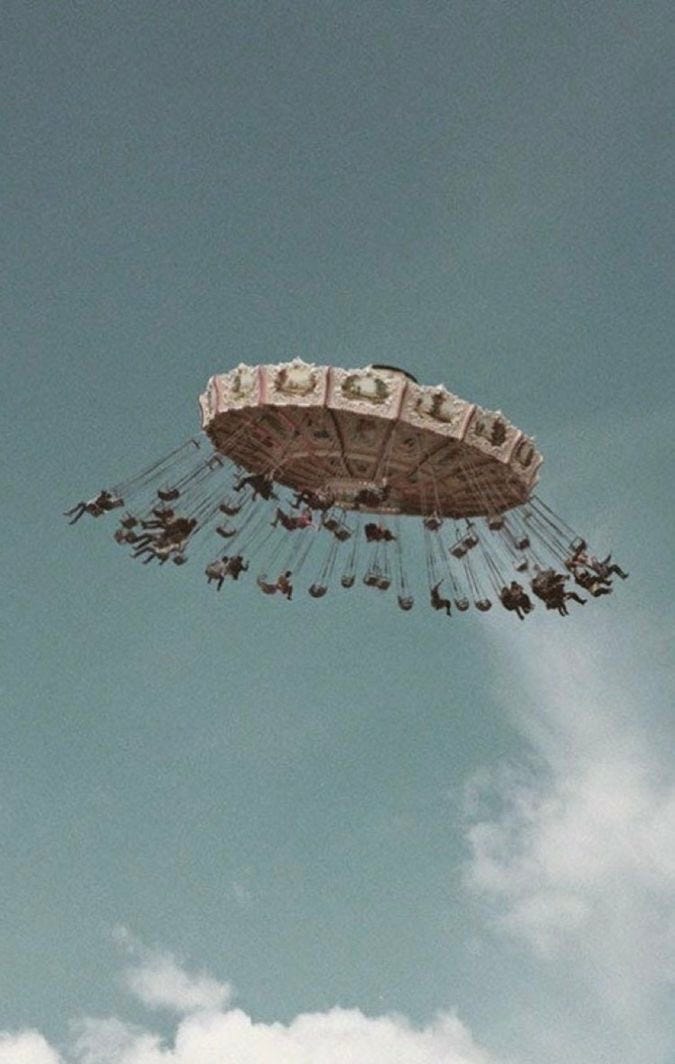
If you haven’t tried them, the goggles are quite a thing. Digital images appear floating in front of you, somehow inside the room you’re sitting in. Your eyes act as the cursor. A small pinch of your fingers selects things. Turn a dial and the physical world disappears.
Naturally we wanted to test the full cinematic range.
At one point I selected a scene from the F1 movie and suddenly there I was, sitting shotgun next to Brad Pitt as he - buckled me in - to tear around the racetrack.
Friend… there should be a warning label on that feature for women newly single in their forties.
This is not “oh look, Brad Pitt in a movie.” No. His perfectly symmetrical face is suddenly right there, unconscionably close to mine as he manhandles the wheel and whips the car around the track.
Apparently my nervous system did not receive the memo that this was fictional. And I began to medically sweat.
But Brad Pitt, it turns out, was not the real culprit.
The real culprit was the final film I selected: World of Dogs.
Without warning, an extremely enthusiastic Pomeranian appeared in full 3D directly in front of my face. A perfect circle of fluff staring straight into the camera like it was preparing for Best in Show. It was so convincing that I completely forgot I was sitting in the Apple Store in Covent Garden next to my business partners, who also had goggles on, and began petting the air.
Full commitment.
I threw my head back laughing so hard that Joe and Mark had to turn the volume up on their own headsets just to drown me out.
From then on, every time I look in the extremes - all the way up or down, all the way left or right - the world spins in nauseating circles for about thirty seconds.
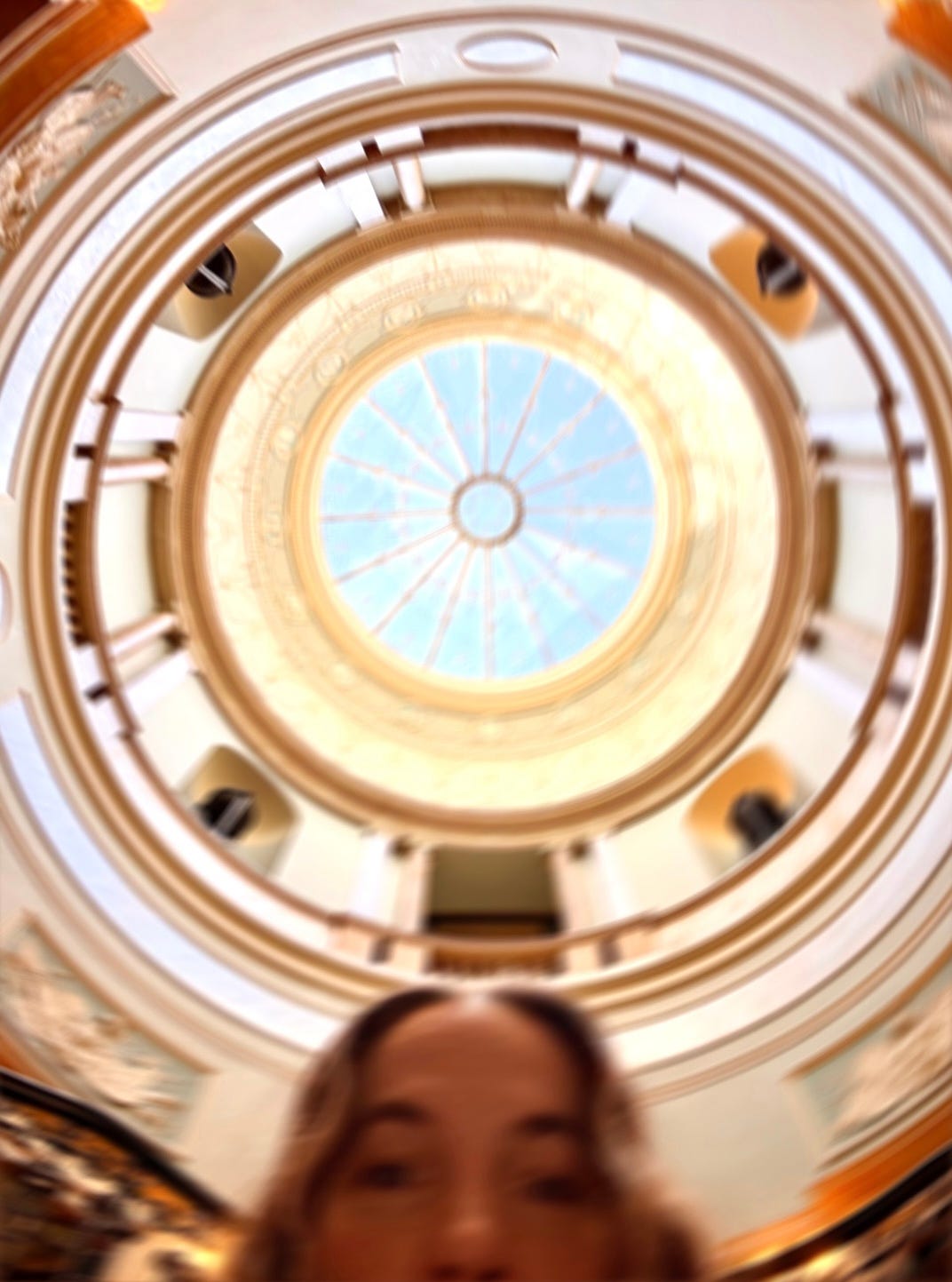
Naturally I consulted my GP, Dr ChatGPT MD.
Apparently the condition is called Benign Paroxysmal Positional Vertigo, or BPPV. A charming inner-ear situation where the tiny crystals that regulate balance get knocked out of place. When you move your head, they move too, and your brain (and nervous system) briefly receives the message that the world is spinning even though it isn’t.
The good news is that it usually resolves itself.
The less good news is that while those crystals are finding their way back home, the sensation is deeply disorienting.
Dr ChatGPT MD also prescribed a simple morning practice:
Before I even get out of bed, I recreate the vertigo on purpose.
I sit up, turn my head toward the ear that sets it off, and then lie back down. The room immediately begins to spin. The instruction is to stay there. Let the spinning happen. Wait until the world steadies.
Then I slowly turn my head the other direction and let the whole thing happen again. Only after the room settles do I sit up. And only after sitting still for a moment do I stand and begin the day. Apparently this is how the tiny crystals eventually find their way back where they belong.
This, strangely, feels like an appropriate diagnosis for the moment we’re living in.

This past week especially, the world has felt like that.
One moment everything feels steady enough.
The next, the ground tilts.
One morning I’m making my first cup of coffee in my new apartment. The next, we’ve bombed Iran.
One minute we’re setting the agenda for the next team meeting. The next minute Mark is helping me understand the China-Venezuela-Iran connections - the oil, the sanctions, and the supply chains that run the show.
One minute my girlfriends and I are on a group FaceTime. The next we’re checking the WhatsApp thread to see if Jen made it safely to a bomb shelter in Beirut.
This is the strange choreography of being alive right now.
The ordinary and the unbearable sharing the same hour.
We open our phones and move from headlines about missile strikes to recipes for French onion pasta in the span of a thumb swipe.
And yet life keeps insisting on its ordinary rituals.
We still make the coffee.
We still pick up the kids from school.
We still admire the lopsided art projects and half-finished science experiments.
And somewhere in the middle of all that, we try to keep feeling the humanity behind the headlines.
This week in my interfaith seminary program, my study group has been preparing to lead our first worship service for our cohort. And this, not surprisingly, became the question we kept circling.
How do we live inside these disorienting extremes?
My role was to choose the sacred text for the service.
The poem I chose felt written for moments when the world tilts like this. It is both teacher and teaching. It steadies you without pretending the world is steady.


