



Dear Friend,
I’m writing to you from Seat 54K, “Economy Delight.” And while I think we may have different definitions of delight, I do appreciate the optimism.
Outside the window, an expanse of white hangs suspended in blue, as if the sky and the ocean have inverted.
It feels like a fitting place to finally write my vows.
If you’re new here, I’ve spent the last two years in interfaith seminary, studying the world’s major religious and spiritual traditions on the path toward ordination. And somehow, after two years of classes, retreats, papers, practices, and prayers, ordination week has arrived.
I made my packing list last night and had to laugh.
Pajamas.
Travel shampoo.
Clergy stole.
Minister’s manual.
Peanut butter protein bars.
The essentials.
A couple of months ago, we were given an assignment: write your Personal Code of Ethics.
If you’ve been reading along, you’ll know I’ve spent the last several weeks wrestling with that question, eventually breaking it down into five smaller questions that felt a little more livable than “How should I live?” (You can read that piece here.)
From that code of ethics, we were then asked to write our Vows of Ministry. The promises we will speak during our ordination ceremony this Wednesday before our cohort, our teachers, ourselves, and the God of our understanding.
If the word “vow” makes your hair stand up, as it did for some of my cohort who carry experiences of religious trauma, my wonderful dean, Reverend Sarah, pointed out that the etymology of the word comes from the Latin ‘votum,’ meaning “solemn promise, dedication, or wish.” Feel free to substitute whichever word allows you to stay in the conversation.

For reasons I can’t quite explain, I’ve found it much easier to talk about ethics than vows.
Ethics feels like a conversation. While, this kind of vow feels like standing naked in front of life’s grandest mirror.
For weeks, I've been carrying them around with me - before sleep, just before waking, on long walks, on flights, in those strange in-between spaces where the deepest questions seem to emerge. An invisible companion.
And then, a few days ago, David Whyte posted one of his older poems. One from his 1997 collection, The House of Belonging.
And as tends to happen with his work, I felt less like I was reading a poem and more like I was being read by one.
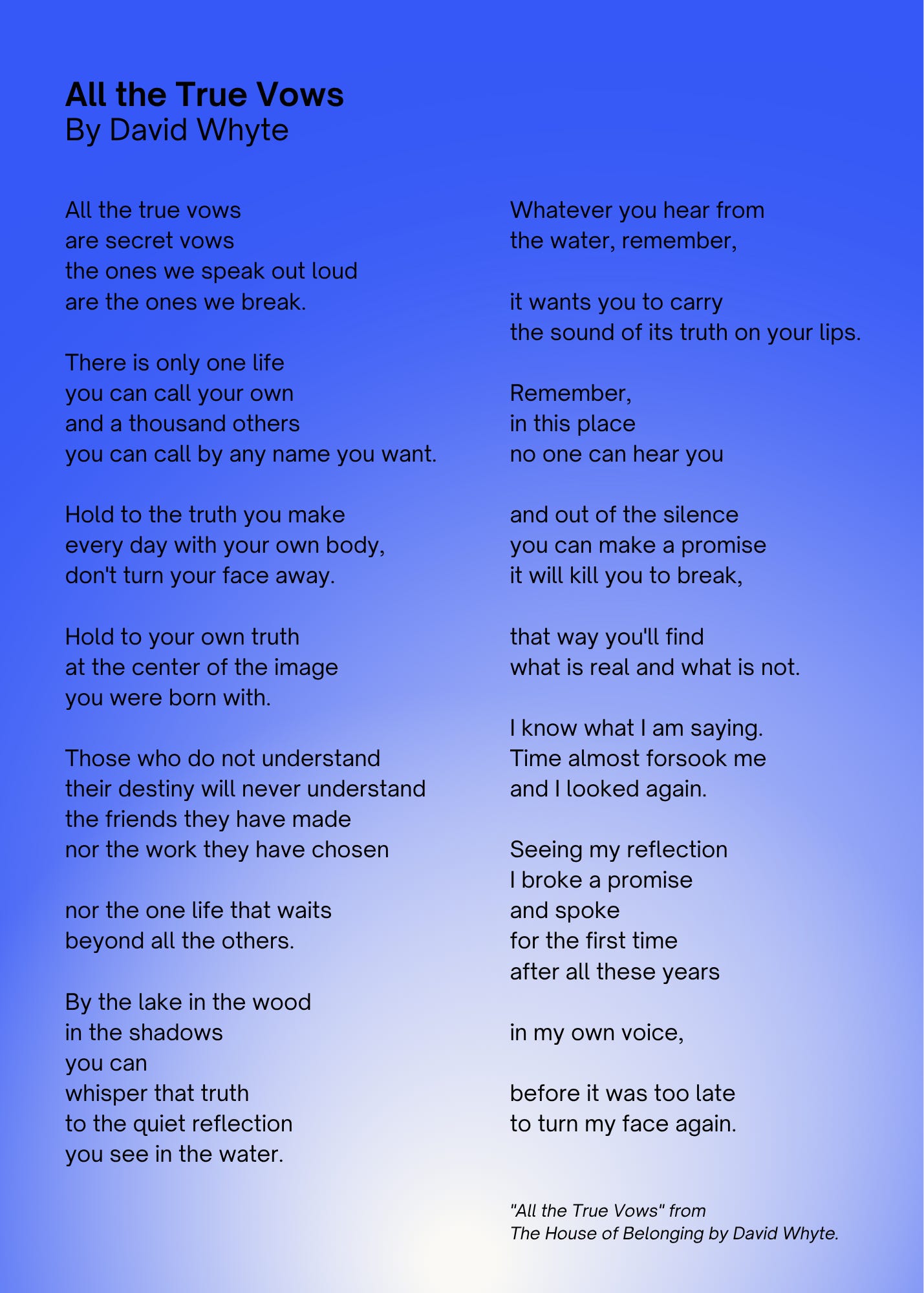
It’s worth giving it a second read - and then a third. Every time I come back to it, a different line grabs me by the collar.
“All the true vows are secret vows.”
Right there is the critical difference between what we declare and what we live. Some promises are so deeply embedded within us that they rarely become language. Others are so intimate they are never shared with another. Still others remain hidden even from ourselves.
“Hold to the truth you make
every day with your own body.”
In your own body. The body reveals where our time goes, what receives our attention, what we repeatedly choose, tolerate, avoid, and return to. The irony, as I aim to write my vows, is that our deepest truths aren’t in our declarations or aspirations, but in the patterns we create through our daily actions. It is actually a very uncomfortable and confronting idea because it asks us to look beyond what we say we believe and toward the life we are actually making. The body, after all, is where our vows become visible.
And then:
“I broke a promise
and spoke
for the first time
after all these yearsin my own voice”
Woof.
In my own voice. There is something both painful and liberating in that realization. Many of us spend years living according to promises we never consciously chose. Promises made to please, to belong, to stay safe, to avoid rejection, to become who we thought others needed us to be.
Reading that line, I found myself wondering: can we truly make new vows, while old allegiances still govern our lives?


